Showing posts with label lithography. Show all posts

Friday, March 2, 2012

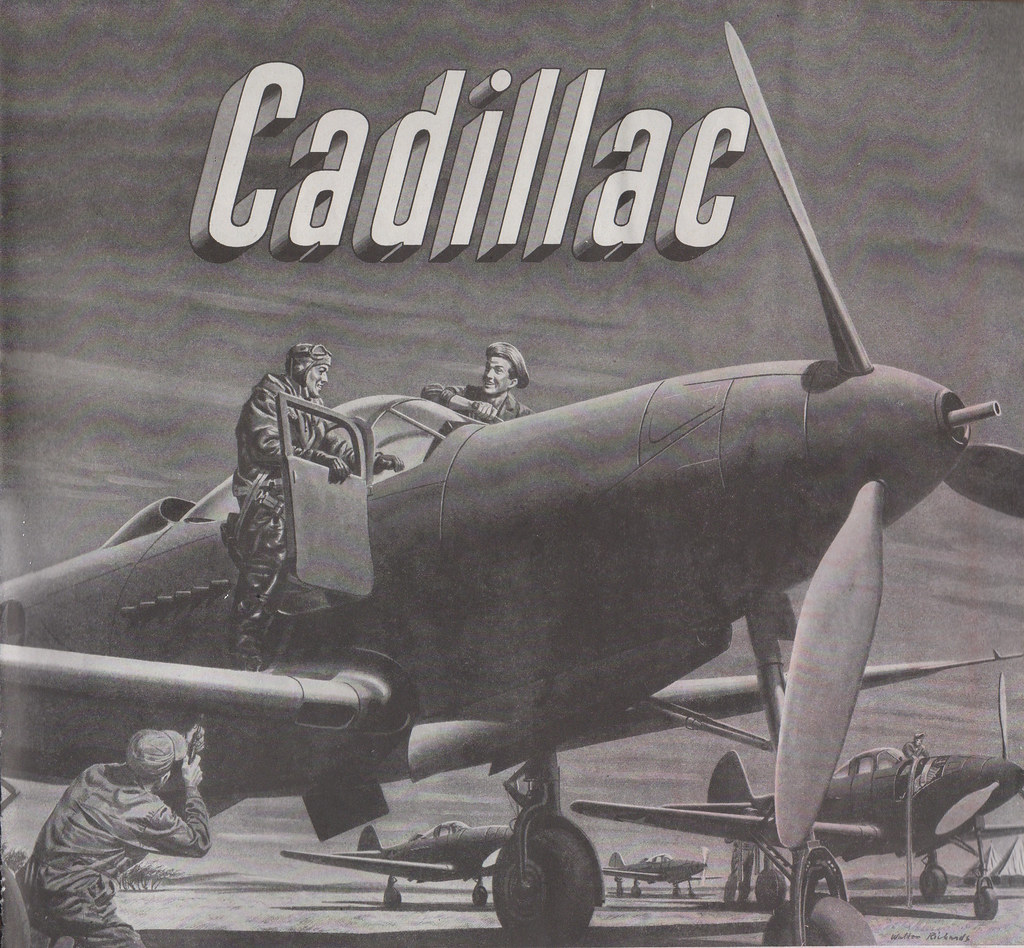
A 1943 Cadillac / Fighter Plane Illustration

WDR World War II Cadillac Advertisement
     Soon after joining the Charles E. Cooper Studio** in the late 1930s, Walter Richards began producing lithographic illustrations for Cadillac, a division of General Motors.  Its possible that Wally's work for Cadillac in the 1930s led into the various illustrations he made for General Motors throughout World War II and beyond.  For example, Walter produced a series of tank illustrations for Cadillac, as well as an illustration for the Bliss-Leavitt Mark 13 torpedo built by Pontiac, also a division of General Motors. 


WDR World War II Cadillac Advertisement


     This illustration, published in Collier's on September 11, 1943, is meant to raise awareness that during WWII General Motors mass-produced precision parts for various machines; such as the Allison transmission found in the above fighter plane. 
     The detail seen in the ground crew's clothes, their ripples, their shadows and reflections; it's all very impressive to me.  I remember that Wally enjoyed working in this war-time atmosphere.  With a wink he would tell me that he was an officer in the military during WWII, and brandish an official-looking military identification.  He explained to me he was given his rank so that he could have priority flying from one assignment to another.  


WDR World War II Cadillac Advertisement
It's worth a read.  Notice the "Buy War Bonds And Stamps" stamp.  


   Starting in 1939, Cadillac began to focus it's manufacturing on producing precision parts for the liquid cooled Allison aircraft engine.  Turns out, WDR made illustrations profiling the Allison Transmission as well.  Impressively, Cadillac had to mass produce with extreme accuracy the machining of over 170 different aircraft parts.  Many of these machine parts required a tolerance grade of no more than three-ten thousandth of an inch.  Wow.  


I'm always interested in any further thoughts/knowledge you (the reader) may know about the illustrations I post, for example:

What type of plane is used for this illustration?
I see there are tents in the background, and the trees seem perhaps tropical in nature?  Is this an airfield in the South Pacific?

** This is a link to Leif Peng's Blog on illustration art titled "Today's Inspiration."   It is an endless and priceless source of information from which I have benefited many times over again and am forever grateful for.

Monday, February 20, 2012

A Biography of Walter DuBois Richards by Helen Barnett

     It is my goal to someday write my own in depth biography of both Walter and Glenora Richards.   But I've decided to include the biography that co-curator Helen Barnett of the Connecticut Graphic Arts Center* wrote for Wally's exhibition in my blog because it is so far the best I've read or found in my efforts researching his career.  Besides being well thought out and organized, it is clear she did her homework, including material she obtained by interviewing both Walter and his wife Glenora.  I am thankful that she did this.


Helen Barnett:

7 Decades Exhibition Biogrpahy      "To telescope the nearly seventy-year career of Walter DuBois Richards, lithographer, painter, designer, illustrator, and teacher into these few paragraphs and illustrations would be frustrating were it not for the accompanying retrospective exhibition.  Viewers will be treated to this phenomenal output and to the scope of his skill in portraying people for magazine editorial and advertising illustrations; in his stunning lithographs of sailing vessels, superb architectural renderings and subtle watercolors.  


     Walter was born on September 18, 1907, in Penfield, Ohio, a small town southeast of Cleveland.  The grandson of a farmer and the son of a high school biology teacher in Rocky River where he grew up, he credits his father's interest in the natural sciences for his own love of nature.  The time he spent at the family cottage on Pun-in-Bay on Lake Erie developed another love - of water, a subject he so eloquently captured throughout his life.  

     After graduating from high school in 1925, he needed money for art school and landed a job as a surveyor. Although untrained in that field he called upon his math and geometry skills as well as his fine draftsmanship to produce accurate calculations and sketches.  That grasp of geometry may account for his later excellent architectural drawings.  "Sometimes I wish I had become an architect," he has mused.


     In 1930 he graduated with honors and a special scholarship from the Cleveland School of Art.  He spent the summer teaching soap carving on the city's playgrounds, a program directed by the Cleveland Board of Education.  Then Walter borrowed $300 from his father and set off for Chicago where he served an apprenticeship at the prestigious Sundblom Art Studio.  The five apprentices were given cab money to deliver artwork, instead they walked and used the money for lunches.  "It was the height of the depression," he recalled, "and I was lucky, especially because there were 40 or more other artists who wanted that position."


     During his eight-month stint he took night classes in life drawings at the Art Institute of Chicago and made a series of illustrations for a children's book, Teepee and Wigwam, after doing much research at the Field Museum.  However, as apprentices were being rotated, he decided to return to Ohio in search of a salary and a bride.  He married Glenora Case whom he had met in art school.  She was doing 20-minute sketches for 25 cents apiece at a Cleveland department store.  Later she would become internationally noted for her miniature paintings.


7 Decades Exhibition Woodcutters      In 1931 he joined the Tranquillini Studios in Cleveland where he met Stevan Dohanos who was to become his life-long friend and professional colleague.  He was with the studio until 1936, during which time he also made a number of lithographs and linocuts for his own enjoyment.  On a trip to Maine with Dohanos to study with Stow Wengenroth he produced a number of lithographs, linocuts and watercolors, scenes of Eastport.


     Though his career as an illustrator and painter/printmaker in Cleveland was moving along, the lure of New York became even more appealing when Steve Dohanos left to join the Charles E. Cooper Studios there.  In 1935 Walter entered a Limited Editions Club competition with a book he had illustrated and designed.  He quite proudly admits that he came in sixth in the nation and had the work exhibited in a Fifth Avenue gallery.  "Steve took Cooper to see my work and it resulted in my being offered a position," he says.  In 1936 he and Glennie packed up and headed East, living in New York at first where she says, "Wally often worked all night and I sometimes slept on the studio couch until he had finished an assignment."


Cadillac Lithograph c1950s Illustration
     Cooper Studios had major accounts and Walter's facile drawing and suberb draftsmanship are evident in advertising illustrations for Cadillac, Ford, and Chevrolet.  Often he had to make finished sketches from photographs of cars still on the assembly line.  In that highly charged competitive environment, his work was much in demand.  "It was the golden age of illustration," he says of the 1920s to the 1950s.  He had the ability to convey any emotion, whether of a glamorous model at a cocktail party or a victom in a gripping murder scene.  These drawings appeared not only in advertisements but as editorial features in Life, Look, Colliers, Argosy, Reader's Digest, This Week, Outdoor Life and American Legion Magazine.


     He left Cooper studios in 1950 and joined Stevan Lyon Studio **(Oops!  I think she meant the ad agency, Stephan Lion Inc., another studio with a similar name in NYC, but a half century older.)** continuing to make illustrations.  He also became an official historian/painter for the U.S. Air Force, traveling around the world - to Germany where he made a watercolor of the Berlin Wall; to Laos, France, Ecuador, and Vietnam where he photographed the horrors of war for use in several paintings, one of which was formally presented to President Johnson at a White House ceremony.  Earlier he had made a painting of the President being sworn into office aboard Air Force One.  


     His extraordinary ability to render portraits, nature and architecture was never more evident than in his designs for thirty-seven U.S. postage stamps, which included the Beautification of America series, the American Bald Eagle, and a twelve-stamp architectural series ranging from Thomas Jefferson's Rotunda at the University of Virginia to Frank Lloyd Wright's Fallingwater.  


     Though a globe-trotter and nationally noted artist, Walter has called Connecticut home since he and Glenora moved to Old Greenwich, and then to New Canaan [Connecticut] where they have lived since 1941.  Their sons Timothy and Henry were reared there and have often recalled that they were sometimes enlisted to pose in various costumes - as cave men, or Martians, or tight rope walkers - for their father's magazine illustrations.  


     Walter has been called a "town treasure" by his legion of admirers, not only for his teaching and guidance, but because he has been the visual and nostalgic chronicler of New Canaan.  In his favorite medium, lithography, he has recorded the old railroad station, the library, Waveny Mansion and the parks in spring and winter.  This work was further lauded in a 1982 Connecticut Society of Architects' Award for Enviromental Improvement which cited him as "one of Connecticut's most respected painters and illustrators whose lithographs, watercolors and drawings have fostered pride in our heritage and have helped preserve historic buildings for future generations."  


Selected Collections and Exhibitions      This recognition is only one in a very long list of awards and prizes Walter has recieved since he first exhibited in the 1933 May Show at the Cleveland Art Museum.  He was given the highest award there in lithography for four consecutive years, 1933 to 1936.  In 1937 six of his lithographs and two linocuts were included in the Whitney Museum of American Art exhibition, Paintings and Prints by Cleveland Artists.  The same year he participated in an international exhibition in Paris, and at the Pennsylvania Academy of Art.  In 1966 his work was included in Two Hundred Years of Watercolor Painting in America at the Metropolitan Museum of Art; and ten years later, in Two Hundred Years of American Illustration at the New York Historical Society.  


     His most recent accolade was the selection of his 1935 linoleum cut, Woodcutters, for inclusion in the catalogue Prints at the Smithsonian, the Origins of a National Collection, published in conjunction with an exhibition celebrating the 150th anniversary of the Smithsonian Institution in the Hall of Graphic Arts.  He was, in good company, "along with Durer and Rembrandt."


     *To give credit where credit is due, I've included Helen Barnett's name and the non-profit organization she worked for in 1999 (and might still).  I looked and did not find a website for the Graphic Arts Center.  I did find the following description on an unrelated website:  "The Connecticut Graphics Arts Center was founded in 1995 as a non-profit, multi-media studio workshop and gallery devoted to the creation of original prints, photographs, artists' books and related disciplines through its year-round workshops conducted by nationally recognized master printers.  Visitors may see changing exhibitions, and view artists making prints.  Free."  The Connecticut Graphic Arts Center is located in Mathews Park, 299 West Avenue, Norwalk, CT.

Friday, February 3, 2012

'Owl' by William Service with drawings by Walter Richards

   
Owl by William Service 1969     Throughout his career, Wally used Animals for subjects in his fine art and illustrations.   Popular choices included cats, dogs, bears, birds of all kinds, dear, fish; and much more.  You name it, chances are, he drew it.  In this case he made several drawings of an owl for the book 'Owl' written by William Service.   The (very short) novel was published in 1969, and its charm reminds me of Gavin Maxwell's autobiographical novel about his relationship with an adopted Iraqi-born Sea Otter in 'Ring Of Bright Water.'   

Owl_Walter_DuBois_Richards_Illustration_p9

     These illustrations are fantastic examples of the enthusiasm Walter DuBois Richards had for drawing wildlife, even if that wildlife was in the form of a pet, such is the case in Owl.  

Owl Illustration by Walter DuBois Richards p47

Owl by Walter DuBois Richards

Friday, January 27, 2012

Boys' Life Magazine, June 1965: "The Image"

     Many of Walter DuBois Richards' illustrations were composed in black and white, like the one below.  This may be a lithograph, or at least drawn in lithographic crayon.  However, it is probably done in pen and ink or even pencil.    
     In this illustration, Wally does a good job finding the essence of the harrowing experience of the hunter that this short story is based on: escaping a forest fire.  

The_Image_Boys_Life_June_1965_Story_Illustration
Boys' Life, June 1965.  Story "The Image" by A.B. Guthrie Jr.  


     The story seems rather fanciful.  A hunter in Lolo Forest outside Missoula, Montana finds himself running from a raging forest fire, only to discover he is being followed by a trail of wildlife; a grizzly, a bull elk, two black bears, a mule deer, a snowshoe rabbit, and two fool hens.  
     Whether or not it is true, the short story is entertaining enough to keep the reader reading on.  Written by A.B. Guthrie Jr..